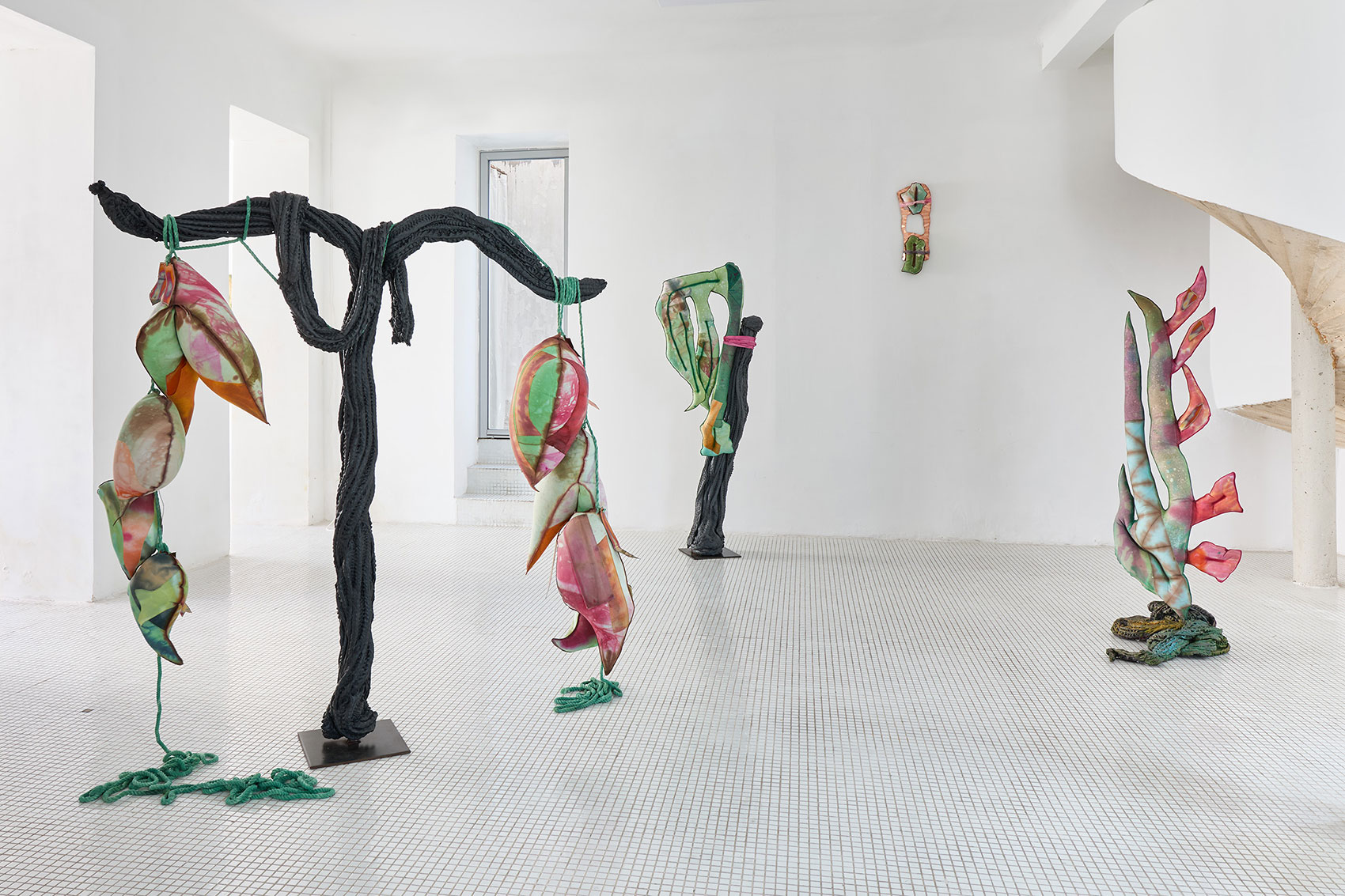
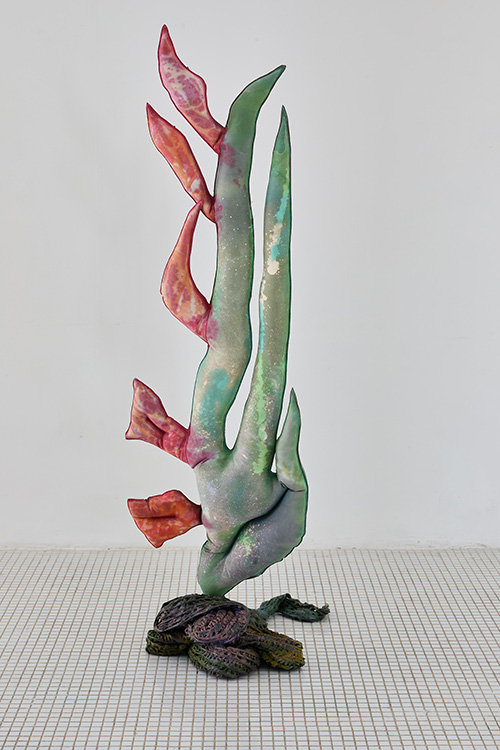
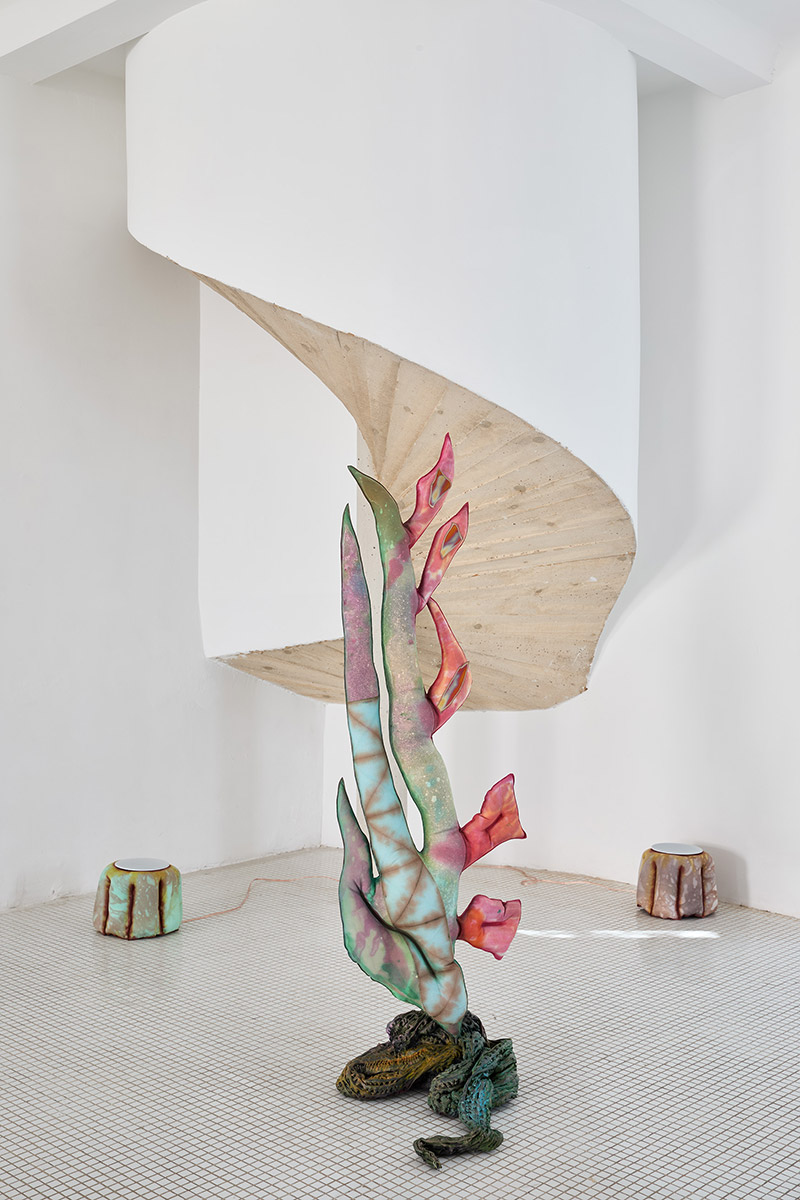
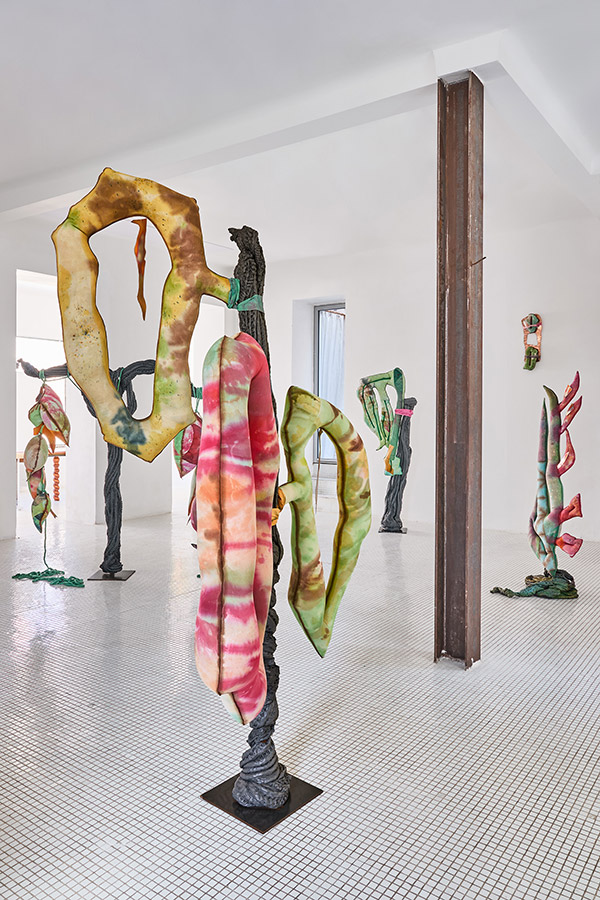
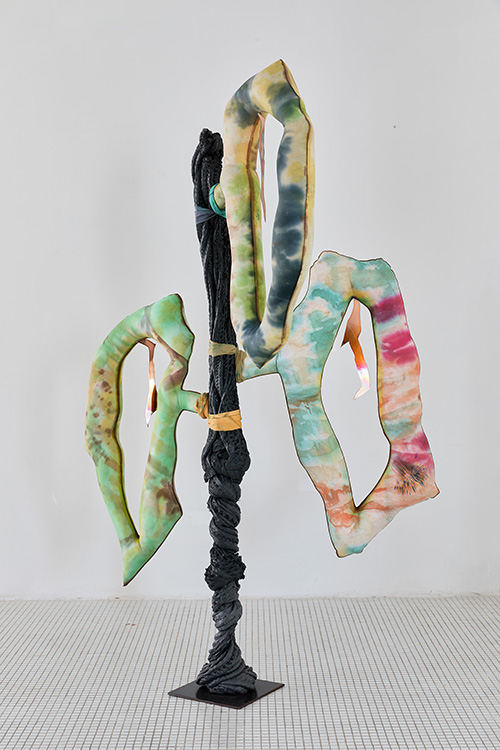
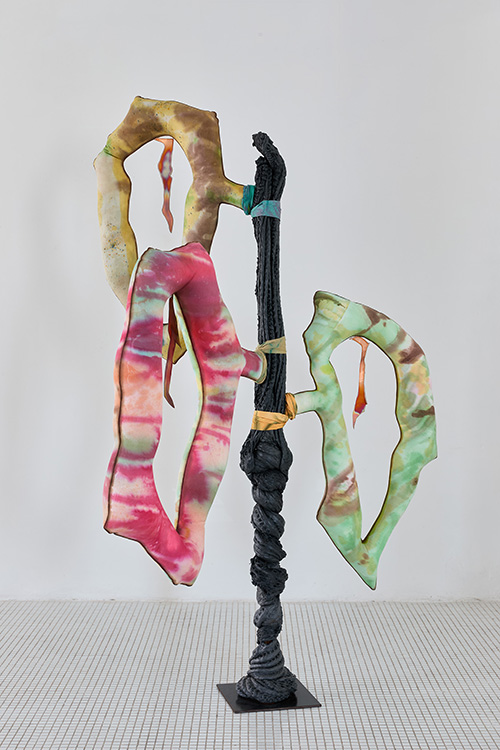
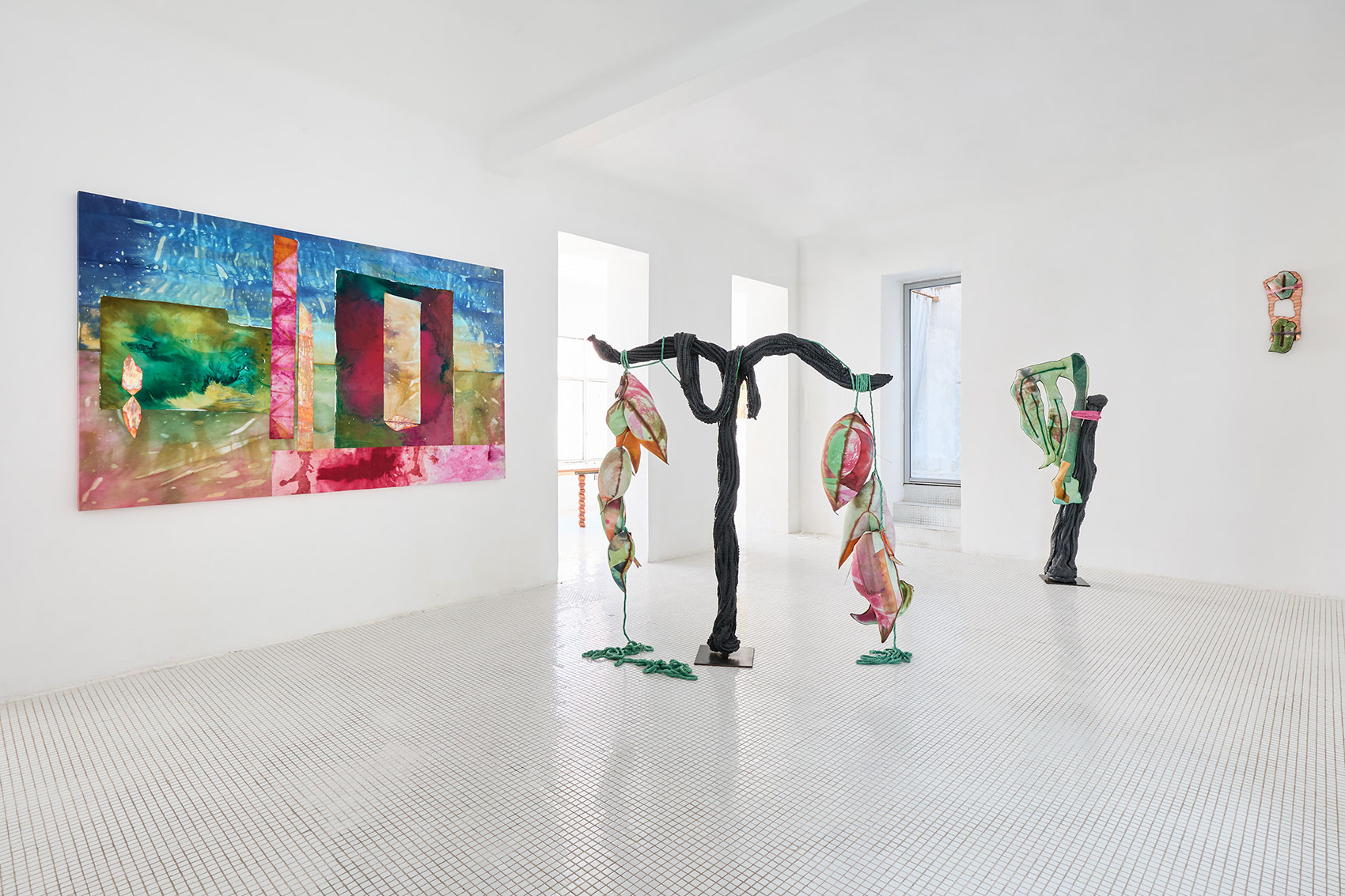
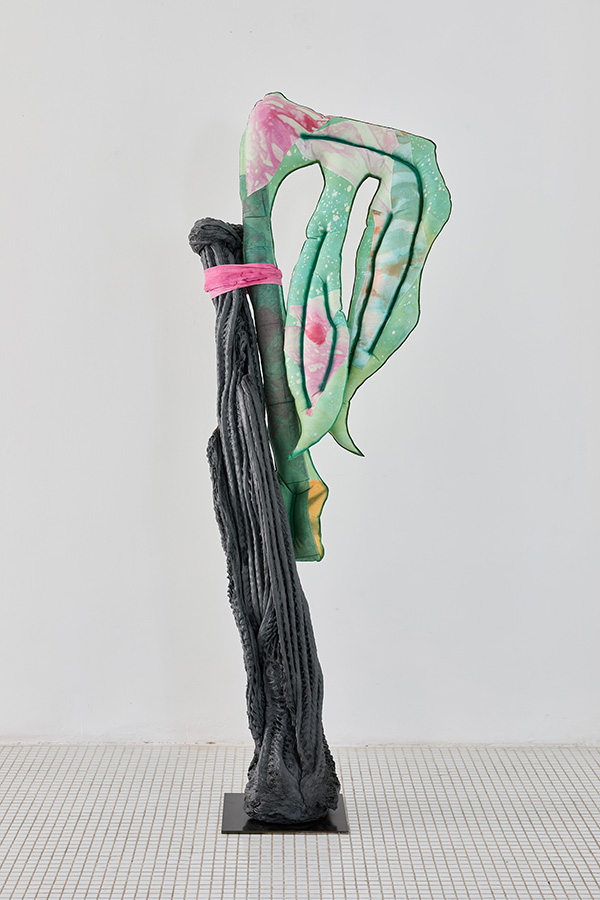
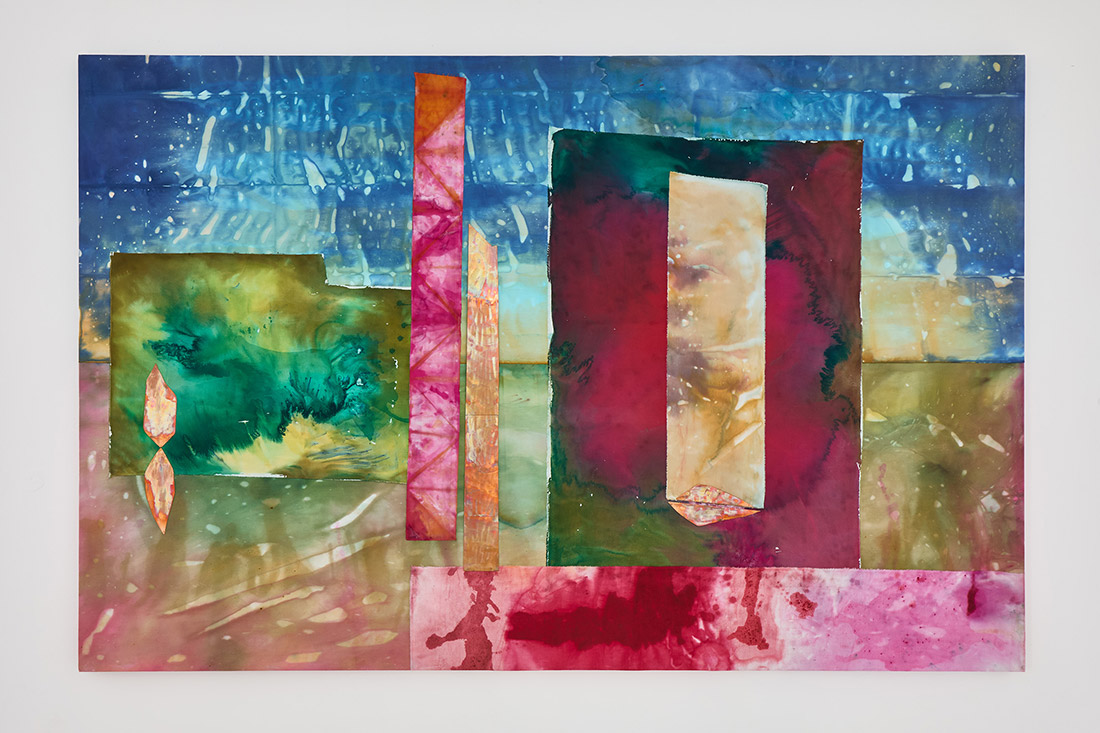
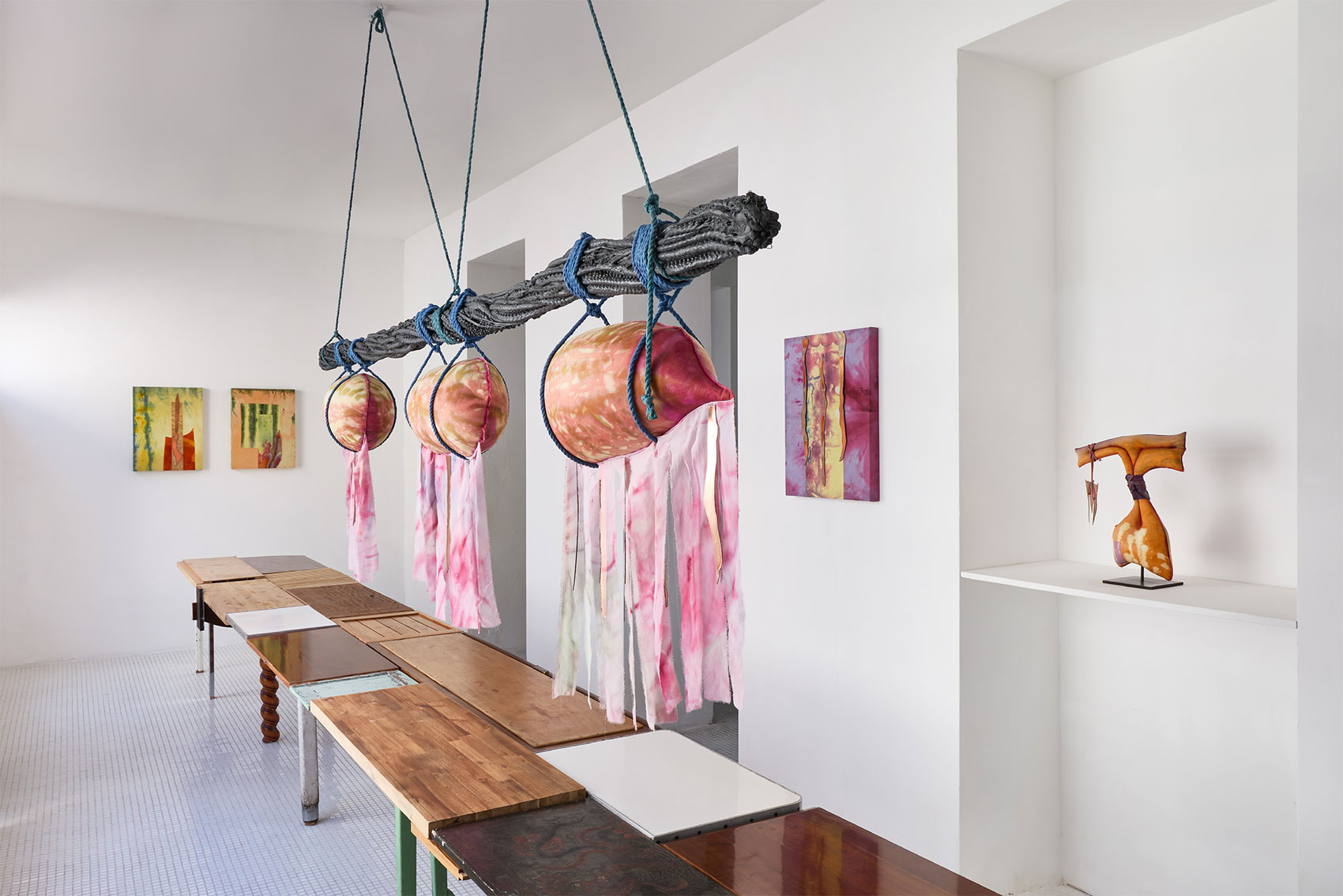
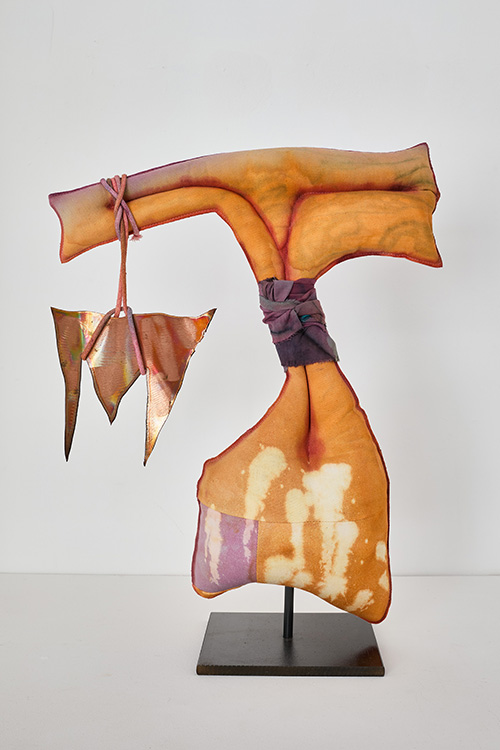
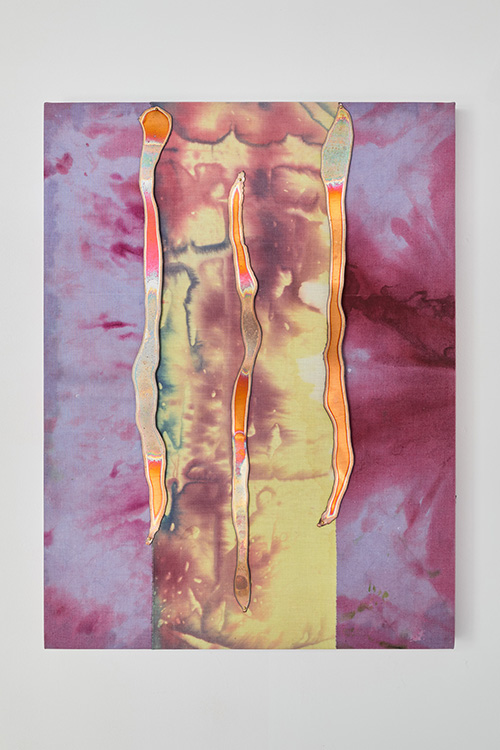
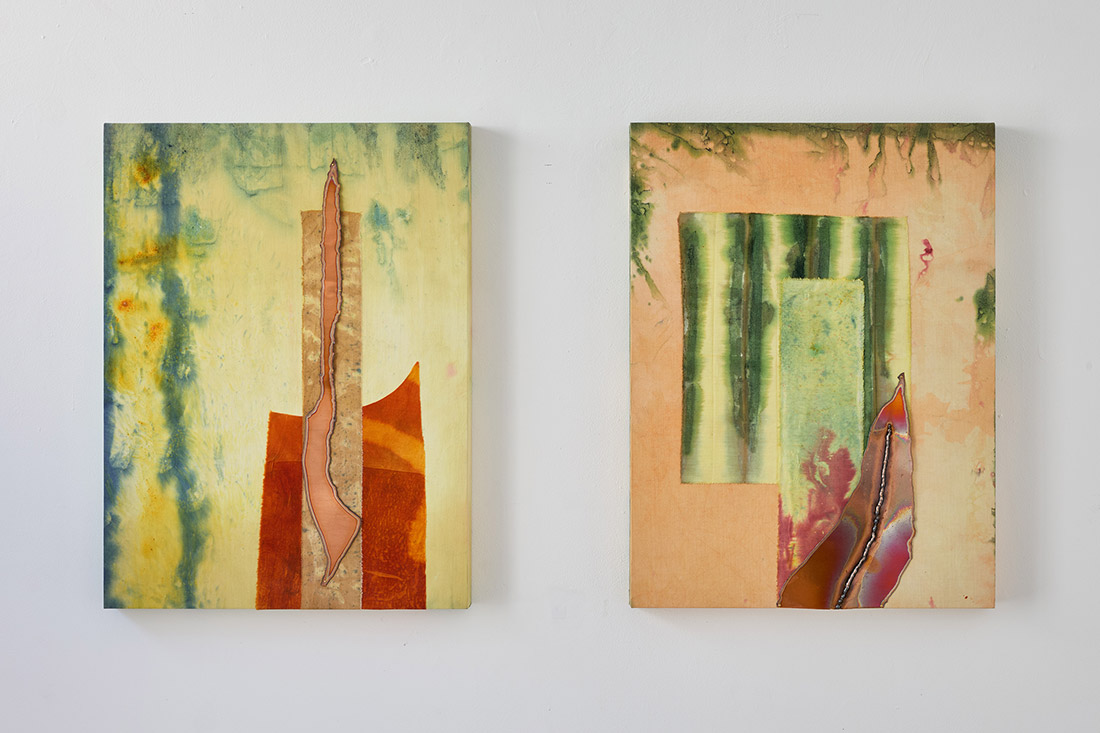
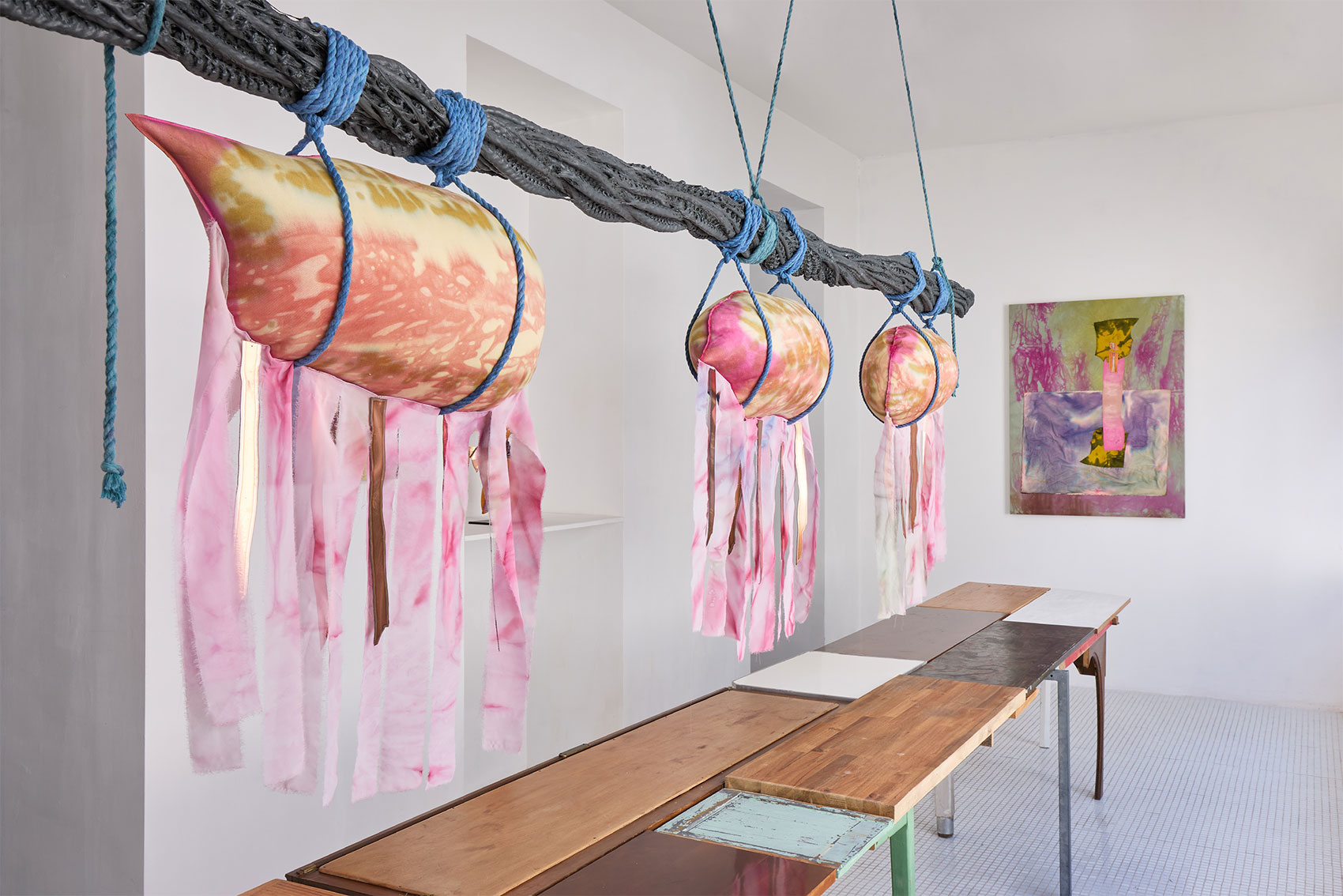
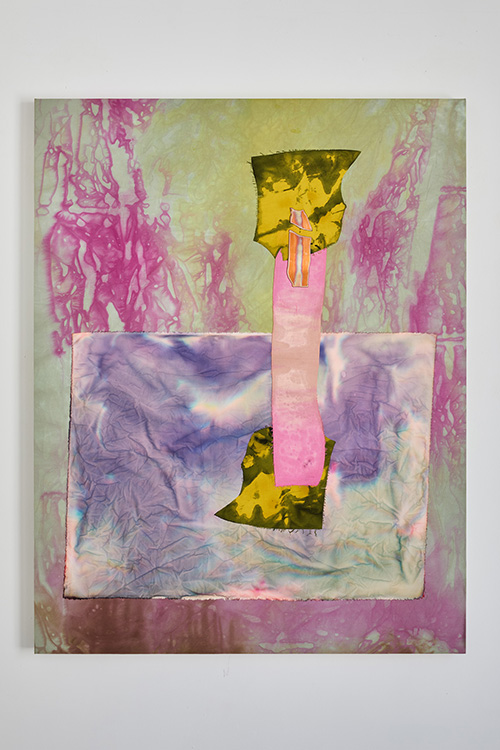
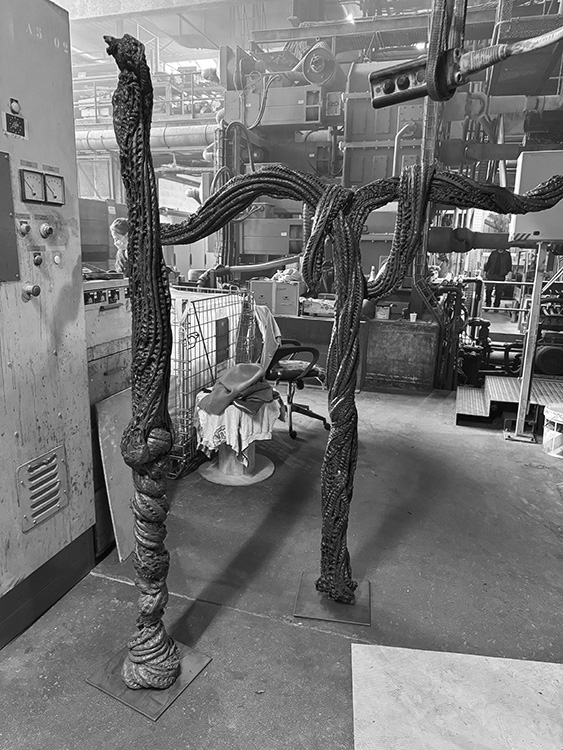
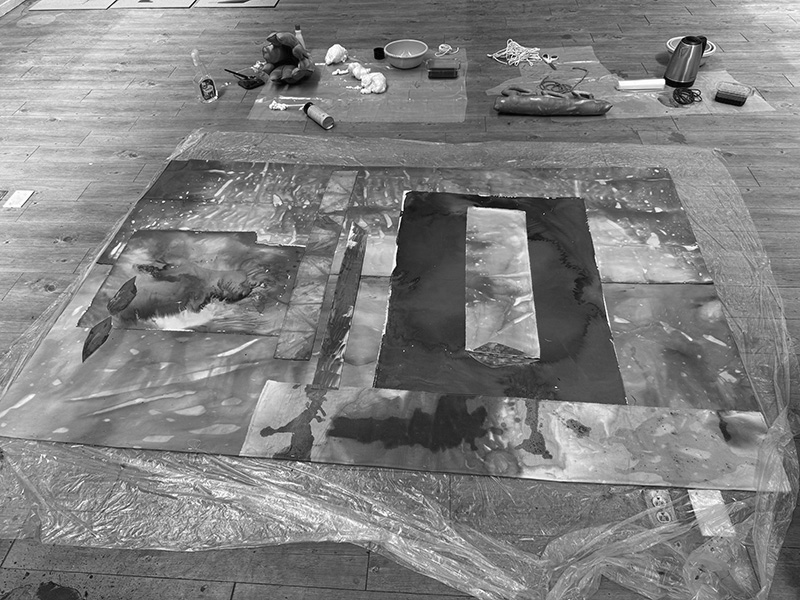
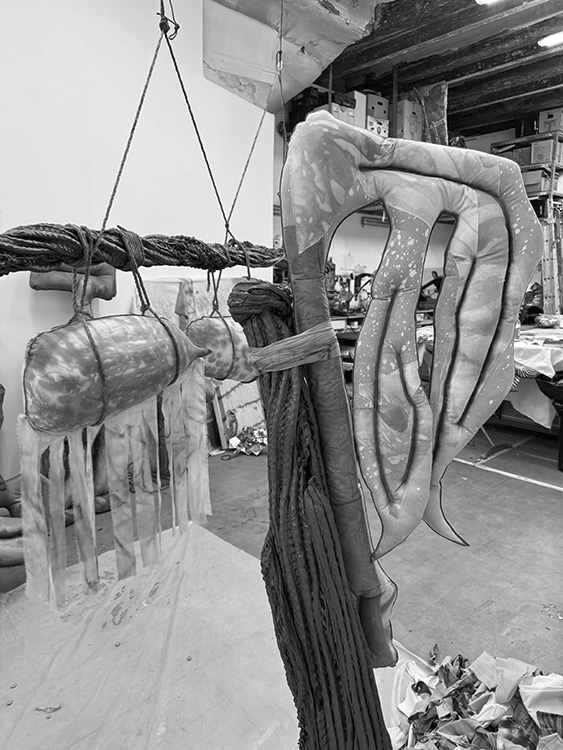
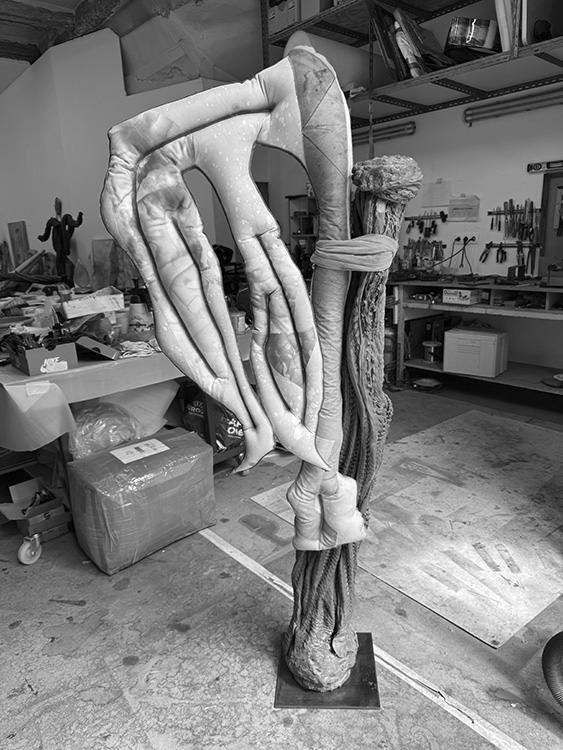
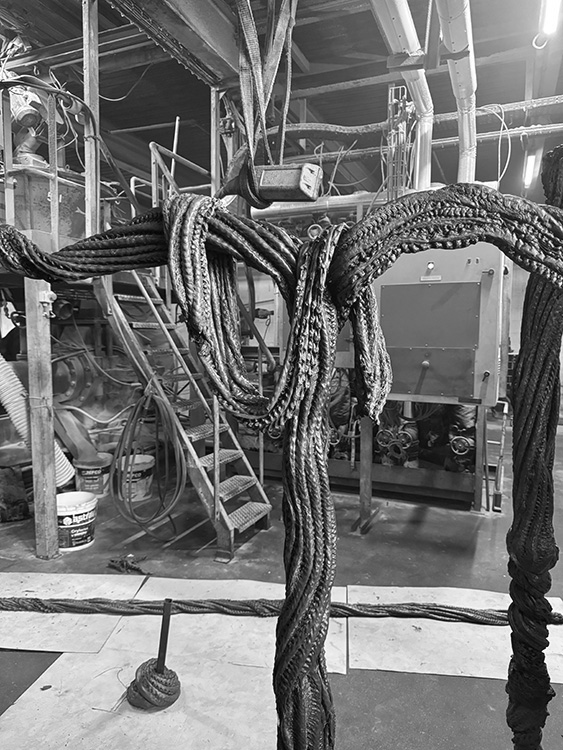
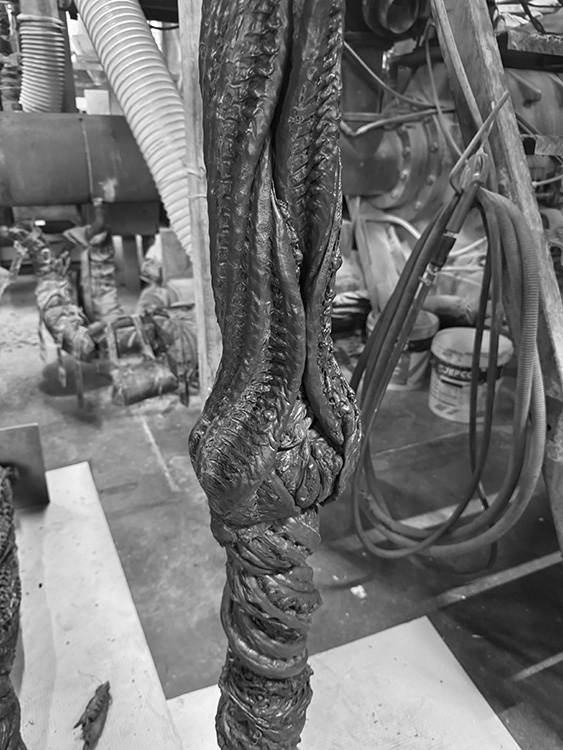
Vues de l'exposition Fuegophillia, La Traverse, Marseille, 2025
Photos Jean-Christophe Lett
Views of the exhibition Fuegophillia, La Traverse, Marseilles, 2025
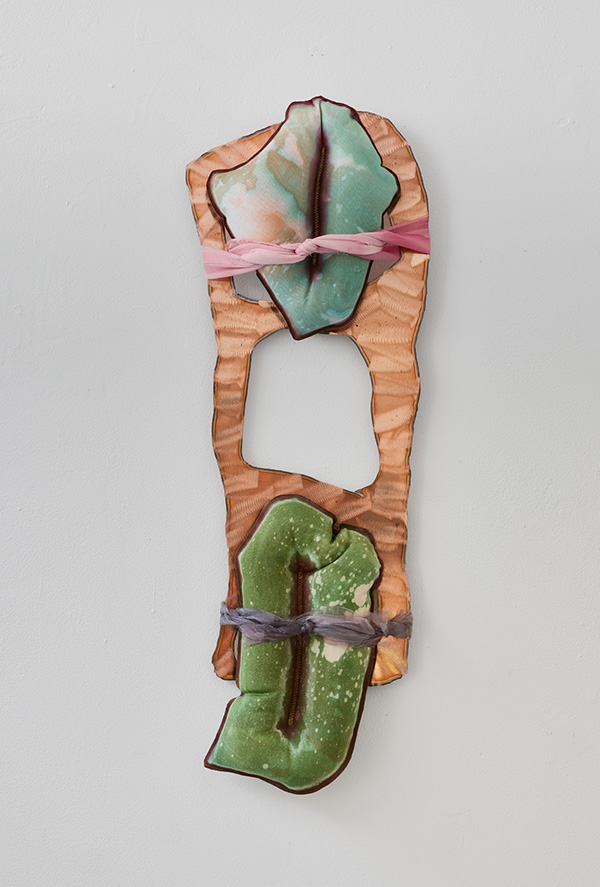
Rosa Épine 2023
Tissu teint, cuivre brûlé, sur bois, 65 × 45 × 5 cm Dyed fabric, burnt copper on wood
Wonderful Wound 2023
Tissu teint, cuivre brûlé, sur bois, 65 × 45 × 5 cm Dyed fabric, burnt copper on wood
Green Patch 2023
Tissu teint, cuivre brûlé, sur bois, 65 × 45 × 5 cm Dyed fabric, burnt copper on wood
Future Hanging Grove 2025
Tissu teint, cuivre brûlé, cordes, PVC recyclé, environ 330 × 120 × 50 cm Dyed fabrics, burnt copper, recycled PVC
Form at Dusk 2025
Tissu teint, cuivre brûlé, PVC recyclé, 122,5 × 95 × 5 cm Dyed fabrics, burnt copper, recycled PVC
Texte de Clara Darrason
« Le feu suggère le désir de changer, de brusquer le temps de porter toute la vie à son terme, à son au-delà. Alors la rêverie est vraiment prenante et dramatique ; elle amplifie le destin humain ; elle relie le petit au grand, le foyer au volcan, la vue d’une bûche et la vue d’un monde. L’être fasciné entend l’appel du bûcher. Pour lui la destruction est plus qu’un changement, c’est un renouvellement. » Gaston Bachelard, Psychanalyse du Feu, 1938
L’amitié qu’Amandine Guruceaga voue au feu prend naissance dans la contemplation du four utilisé par ses parents, émailleurs sur métaux de profession. Se dessinent en creux certains fondamentaux de sa pratique : l’observation des gestes et techniques artisanales ; l’apprivoisement du modelage de la matière, avant qu’elle ne soit léchée par les flammes ; l’appréciation des variations chromatiques des émaux, appliqués en gestes picturaux, puis fondus ou vitrifiés. Guruceaga contourne, depuis, l’apparente immuabilité des matériaux par le biais de divers savoir-faire ancestraux et de procédés plastiques expérimentaux qu’elle a imaginés.
La résilience opère comme une matrice et trouve une triple acception dans son œuvre : celle de la résistance d’un matériau après un choc (on parle de coefficient de résilience) ; celle, par extension dans le champ écologique, d’un système vivant à résister à des perturbations et à revenir à l’équilibre ; enfin, la capacité psychologique à rebondir (à l’étymologie même du mot, du latin salire — sauter), à dépasser ou survivre à un traumatisme.
Guruceaga s’est ainsi passionnée pour les plantes pyrophytes – dont la particularité est de résister ou tirer profit des incendies pour se reproduire.
Tandis que des espèces comme le chêne liège ou le séquoia géant se protègent grâce à l’épaisseur de leur écorce, pour d’autres, à l’image des cistes ou du pin d’Alep, la germination sera favorisée par la chaleur extrême. L’eucalyptus est un cas unique : il produit des vapeurs inflammables qui favorisent la combustion, et conserve à l’issue de l’embrasement son hégémonie territoriale. Ces diverses stratégies de résistance ou d’adaptation au feu ont constitué un terreau de réflexion pour l’artiste, qui adopte, dans son engagement politique et environnemental, une posture tournée vers l’exploration des réponses contemporaines et ancestrales — comme le brûlage préventif pratiqué par les peuples autochtones — face aux ravages du réchauffement climatique.
Ainsi dans Fuegophillia, le feu sort du foyer pour dévorer le paysage et le féconder. Cette ambivalence se traduit par des compositions picturales alliant des tissus teints et tendus sur châssis au cuivre ou laiton brûlé. This Fire That Licks the Landscape, qui s’étend sur plus de deux mètres, s’offre comme une plongée ambiguë dans un paysage crépusculaire dominé par le rouge cramoisi, le vert tilleul, le rose fuchsia et le cuivre roussi, déployés sur une étendue bleu céleste délavée. Les sculptures invoquent la fertilité par des graines aériennes, conçues à partir de textiles gonflés de mousse expansive, disproportionnées, presque exagérément dilatées dans l’espace habituellement réservé aux branches. Les troncs noirs qui les soutiennent sont en PVC recyclé et modelés à chaud à leur sortie de l’extrudeuse. Guruceaga contorsionne leur texture caoutchouteuse et reptilienne, rappelant l’image sinistrement contemporaine d’une roue de véhicule fondue sur le bitume. Graines (fleurs ou fruits) et troncs sont reliés par des bandes de tissu ou des cordes suspendus, créant une esthétique d’assemblage qui évoque un corps en rémission. L’artiste emploie d’ailleurs dans ses titres un champ lexical chirurgical et biologique : La Greffe, 3 Embryos Fire, 2 cœurs 2 nœuds.
C’est dès lors vers une éthique de la sollicitude que Guruceaga oriente son geste – attentive à privilégier l’emploi de matériaux issus de la récupération ou recyclables – y compris lorsqu’ils sont d’origine synthétique. Dans des conditions de vie de plus en plus extrêmes, les œuvres de Fuegophillia provoquent un contraste d’une intensité presque hallucinatoire entre puissance vitale et anéantissement. La composition musicale immersive du groupe de rock psychédélique français Moodoïd, conçue pour l’exposition, agit comme un liant vibratoire entre les œuvres, tissant une transe sonore à la fois expérimentale et fantasmagorique. L’état d’alarme permanent et la rêverie devant le feu forment une cohabitation archaïque qui soumet pourtant notre espèce à certaines limites de soutenabilité. Au large, cette même tension habite l’horizon – le miroitement méditatif des vagues de l’anse de Malmousque venant se briser sur le rocher des Pendus.
Text by Clara Darrason
“Fire suggests the desire to change, to speed up the passage of time, to bring all of life to its conclusion, to its hereafter. In these circumstances the reverie becomes truly fascinating and dramatic; it magnifies human destiny; it links the small to the great, the hearth to the volcano, the life of a log to the life of a world. The fascinated individual hears the call of the funeral pyre. For him destruction is more than a change, it is a renewal.” Gaston Bachelard, Psychanalyse du Feu, 1938
Amandine Guruceaga’s friendly devotion to fire was born from contemplating the kiln used by her parents, both professional metal enamellers. This early, foundational experience shaped the contours of her artistic practice: observing artisanal gestures and techniques; taming materials before their forms are licked by the flames; and appreciating the chromatic variations of enamels, applied in painterly strokes, before being melted or vitrified. Since then, Guruceaga has circumvented the apparent immutability of materials by devising experimental processes and drawing on various forms of ancestral savoir-faire.
Resilience operates as a matrix and takes on a threefold meaning in her work: first, the resistance of a material after impact (known as the resilience coefficient); second, by extension into the ecological field, the ability of a living system to withstand disturbances and return to equilibrium; and finally, the psychological capacity to bounce back — rooted in the very etymology of the word, from the Latin salire, meaning; to jump; — to overcome or survive trauma.
As a seamless extension of her exploration, Guruceaga developed a fascination for pyrophytic plants — species that have the remarkable ability to resist or even benefit from fire to reproduce. While some, like cork oak or giant sequoia, protect themselves through the thickness of their bark, others — such as rockrose or Aleppo pine — rely on extreme heat to trigger germination. The eucalyptus is a unique case: it emits flammable vapors that encourage combustion, enabling it to retain territorial dominance after the blaze. These diverse strategies of resistance and adaptation to fire have become fertile ground for the artist’s reflection. In her political and environmental engagement, she adopts a stance oriented toward exploring both contemporary and ancestral responses — such as the preventive burning practices of Indigenous peoples — to the devastation caused by global warming.
In Fuegophillia, fire escapes the hearth to devour and fertilize the landscape. This ambivalence is expressed through paintings combining stretched dyed fabrics and burnt copper or brass. This Fire That Licks the Landscape, which spans over two meters, offers an ambiguous immersion into a twilight scene dominated by crimson red, lime green, fuchsia pink, and scorched copper, all set against a faded celestial blue expanse. The sculptures invoke fertility through aerial seeds, made from textiles inflated with expanding foam—disproportionate and almost exaggeratedly swollen in the space usually reserved for branches. The black trunks supporting them are made of recycled PVC, hot-molded immediately as it leaves the extruder. Guruceaga contorts their rubbery, reptilian texture, recalling the grimly contemporary image of a vehicle tire melted onto asphalt. Seeds (flowers or fruits) and trunks are connected by strips of fabric or suspended ropes, creating an assemblage aesthetic that evokes a body in remission, while the artist employs a surgical and biological lexical field in her titles: La Greffe (The Transplant) , 3 Embryos Fire, 2 Hearts 2 Knots.
From then on, Guruceaga directs her gesture toward an ethics of care—mindful to prioritize the use of recovered or recyclable materials, including those of synthetic origin. In increasingly extreme living conditions, the works of Fuegophillia create a contrast of almost hallucinatory intensity between vital force and annihilation. The immersive musical composition by the French psychedelic rock band Moodoïd, conceived for the exhibition, acts as a vibratory binder between the works, weaving a sonic trance that is both experimental and phantasmagoric. The constant state of alarm and the reverie before the fire form an archaic cohabitation that nonetheless subjects our species to certain limits of sustainability. Offshore, this same tension inhabits the horizon—the meditative shimmering of the waves in Malmousque Cove breaking against the Rock of the Hanged Men.