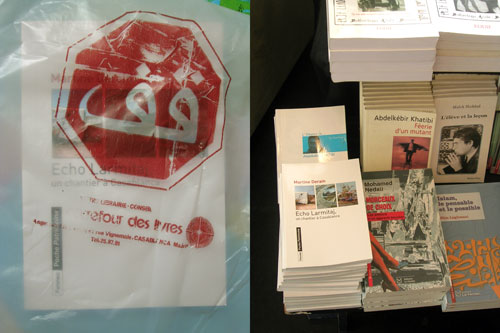
Echo Larmitaj, un chantier à Casablanca
Un livre édité par les Editions Le Fennec, Collection Poche Patrimoine | 2006
english version
Le parc de l’Hermitage, à la périphérie du centre-ville de Casablanca, est un petit territoire : 18 hectares, propriété de la Ville, l’un des rares espaces verts de la capitale économique du Maroc, qui compte plus de 5 millions d’habitants.
Il jouxte les quartiers populaires de Nouvelle Medina, Derb Foqara ou El-Miter Bouchentouf, haut lieu de la résistance contre les Français et contre le régime de Hassan II. Créé sous le protectorat français, abandonné et devenu décharge publique, le parc est depuis quelques années un objet de passions : des citoyens, des artistes, des hommes politiques se sont mobilisés. Ils ont lancé un processus de restauration, qui s’inscrit dans le cadre plus général de la réhabilitation du patrimoine casablancais et de ce qu’il est convenu d’appeler l’émergence de la société civile au Maroc.
Le récit commence en 1999, lorsque des citoyens associés à des artistes attirent le regard des autorités : Abdellah Zaâzâa de l’Association El Miter Bouchentouf pour le Développement Social et Eymeric Bernard, cinéaste, produisent des petits films documentaires et organisent des projections dans le parc et dans le quartier. En 2002, la Source du Lion, association d’artistes plasticiens, conçoit une intervention : la construction collective d’une maquette du parc au 100ème, 18 m2, l’Hermitage dans son état réel, une maquette comme un constat. Exposée à la Villa des Arts en mai 2003, l’un des seuls lieux d’art contemporain de la ville, elle sera selon le souhait de ses auteurs, un élément déclencheur de la réhabilitation : c’est le jour du vernissage que M. M’Hamed Dryef, wali du Grand Casablanca, déclarera publiquement ouvert le chantier réel du parc. Deux semaines plus tard, les milliers de tonnes d’ordures seront évacuées. Pendant les deux années qui suivirent, les interventions des artistes, l’attention des responsables politiques et le soutien des habitants du quartier ont donné lieu à une expérience singulière, où ont été mises en forme des modalités d’actions et d’interactions qui ne peuvent être que d’ici, où l’on préserve l’existant, où l’on s’appuie sur les savoir-faire et les possibles… J’ai choisi d’arrêter mon récit à la veille de la réhabilitation «lourde» du parc, alors qu’il est redevenu un espace dédié «au plaisir des yeux et des oreilles», définitivement à l’abri de l’abandon comme de la spéculation immobilière. La Fondation Mohamed VI pour l’environnement a décidé de missionner un atelier de paysagistes et c’est une autre aventure qui a commencé.
Ce livre est né d’une invitation qui m’a été faite par la Source du Lion lors du workshop réunissant des artistes marocains et européens, organisé autour de l’exposition de la maquette. Chacun était invité à proposer une intervention. J’ai choisi de réaliser un livre de poche pour interroger et transmettre cette expérience — mais toutes les questions soulevées ici résonnent avec celles que je peux me poser dans mes propres interventions, qu’elles concernent la construction de récit ou la représentation d’un territoire… ou la vie tout simplement : que peut un individu ? Je travaille ici les matériaux que j’affectionne : paroles, informations, photographies, documents… J’ai choisi de porter attention au presque rien, aux petits gestes – mais qui ont tous été des éléments déclencheurs essentiels. Je fais la part belle aux images qui ne sont pas ou ne seront plus montrées, telles les photographies prises au cours du repérage nécessaire à la construction de la maquette. J’ai mis en forme ce récit collectif au cours de trois séjours d’écriture en décembre 2004, mai et juillet 2005, au cours desquels j’ai rencontré les acteurs du projet. Les Editions Le Fennec, Casablanca, ont accepté d’éditer mon livre : c’est le premier numéro de leur toute nouvelle collection Poche Patrimoine. Un petit format, bon marché, aujourd’hui diffusé aussi bien en centre-ville que dans les petites librairies de quartier, un petit livre que j’aimerais voir comme une invitation à la promenade sous les eucalyptus du parc… et à l’action ?
M.D. novembre 2006
Echo Larmitaj est en vente :
A Paris : Institut du Monde Arabe
A Marseille : Association Commune | Editions La Courte Echelle | Librairie L’Odeur du Temps | Librairie Regard | Librairie Le Lièvre de Mars | Librairie Histoire de l’Œil | Librairie Orientale
A Casablanca : Atelier de La Source du Lion | Librairie D.S.M | Librairie Farraire | Librairie de France | Librairie Maârif culture | Librairie Livre Service Casa | Librairie Khalsi | Librairie Maxi-livres | Librairie Gauthier-livres | Librairie Carrefour des livres | Librairie de A à Z | Librairie Porte d'Anfa | Librairie Le Kootidien | Librairie A la claire fontaine | Librairie l'AN 2000 | Librairie C.I.L | Librairie de Provence
A Rabat : Librairie Kalila Wa Dimna | Librairie Ibn Sina | Librairie Ibn Yassine | Librairie Livres service Rabat | Librairie Basta M'barek | Librairie du 6 novembre | Tabacs Supermarché Suissi
A Mohammedia : Librairie Laâyoun | Librairie Al Moustaqbal
Echo Larmitaj est en consultation libre :
BNF, Paris | Bibliothèque des Sciences de l’Homme du Laboratoire Urbama, Tours (Université François Rabelais) | Centre de documentation du Musée d’Art Contemporain de Marseille | Documents d’artistes, Friche de la Belle de Mai | Institut Français de Casablanca, Maroc | Rijksakademie van beeldende kunsten, Amsterdam | UC Berkeley Library/History of art, San Francisco |
|